
Block Paving in Solihull
Blocks laid on sand over a compacted sub-base, held in by haunched edges. Any block can be lifted and put back, so a repair never means a new drive.
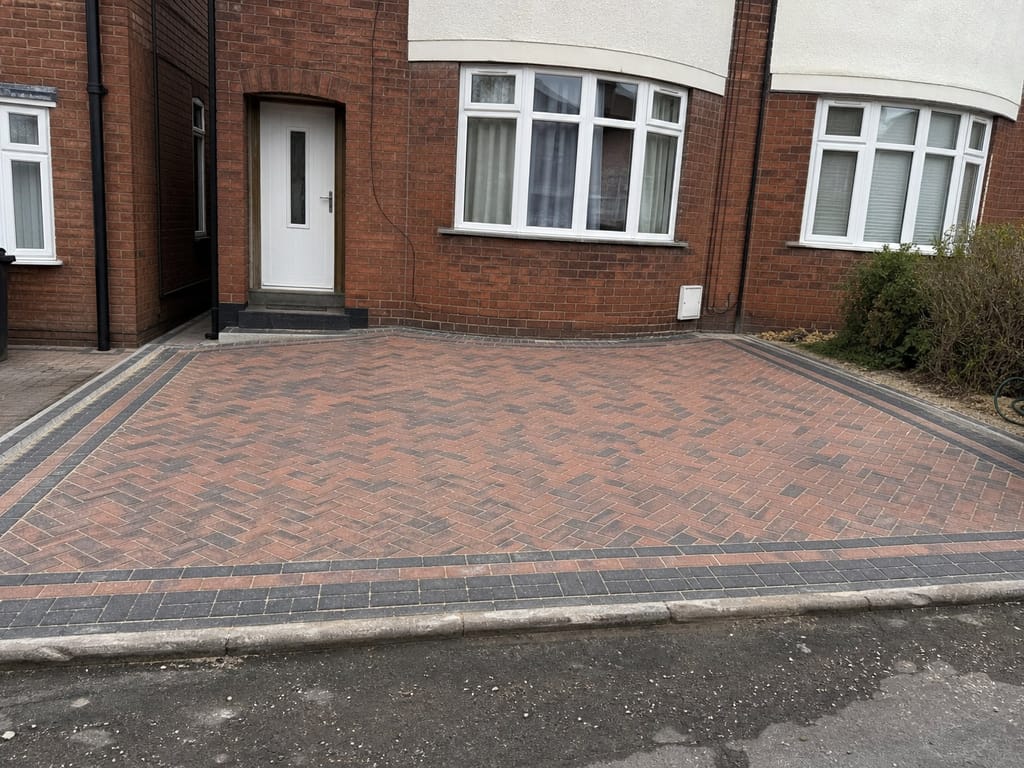
Why people still pick blocks
Two reasons, and neither is fashion. The first is that a block drive can be taken apart. When a water board digs up your service, or a tree root lifts a corner, we pull the blocks, sort the ground out, and relay the same blocks. Nobody is patching a scar into a solid surface. The second is pattern: borders, soldier courses and a change of colour let you mark out where a car goes and where a path goes without any signage.
Those are guide bands taken from published UK cost surveys, not a quote. Your price comes from the survey and is fixed in writing.
Concrete or clay
- Concrete block. The common choice. Wide range of colours, sizes and textures, and the cheapest per square metre. The colour softens over the first few years as the surface weathers.
- Clay paver. Fired, not pigmented, so the colour goes all the way through and stays put. Harder wearing, dearer, and it suits the older brick stock around Solihull better than most concrete ranges do.
- Permeable block. Wider joints filled with grit rather than sand, sitting on a clean stone sub-base so water drains through the joints. This is the option that keeps you clear of planning permission on a front drive.
Laying pattern
Herringbone at 45 or 90 degrees interlocks best and is what we use where cars turn and brake. Stretcher bond looks tidier on a path or a narrow side return but shifts more under turning wheels. Whichever pattern, the perimeter gets a soldier course and a concrete haunch behind it, because a block drive without edge restraint spreads sideways and opens up joints within a couple of winters.
How we build it
- Dig out. Down to formation, spoil loaded and carted away on a licensed ticket.
- Sub-base. MOT Type 1 in layers, compacted between each one, graded to fall away from the house.
- Edgings. Set on concrete and haunched before any blocks are laid.
- Screed. Sharp sand screeded to an even depth so the blocks bed consistently.
- Lay and cut. Blocks laid off the pattern, cuts made with a bench saw rather than a splitter where the cut will be seen.
- Joint and compact. Kiln dried sand brushed in, plate whacked over with a rubber sole, then jointed again until the joints stop taking sand.
Drainage
Water has to go somewhere that is not your front door or the pavement. On most drives that means a fall of roughly one in eighty away from the house, plus a channel drain across the threshold or at the entrance where the ground runs the wrong way. Where the fall cannot be made to work, an aco channel piped to a soakaway is the honest answer, and it goes on the quote as its own line so you can see what it costs.
Aftercare
Top the joint sand back up after the first year, then every few years. Pull weeds early, before they root under the block. Wash it down with a hose or a wide pressure washer fan; a narrow lance held close blasts the joint sand out and leaves the blocks free to move. Re-sand anything you have washed out on the same day.
Price up a block paved drive
Tell us the postcode and roughly how big it is. We measure up and put a fixed price in writing.