
Patios and Paths in Solihull
Slabs on a full mortar bed, falls set away from the house, edges haunched. Steps and paths tied into the same levels so nothing catches a toe.
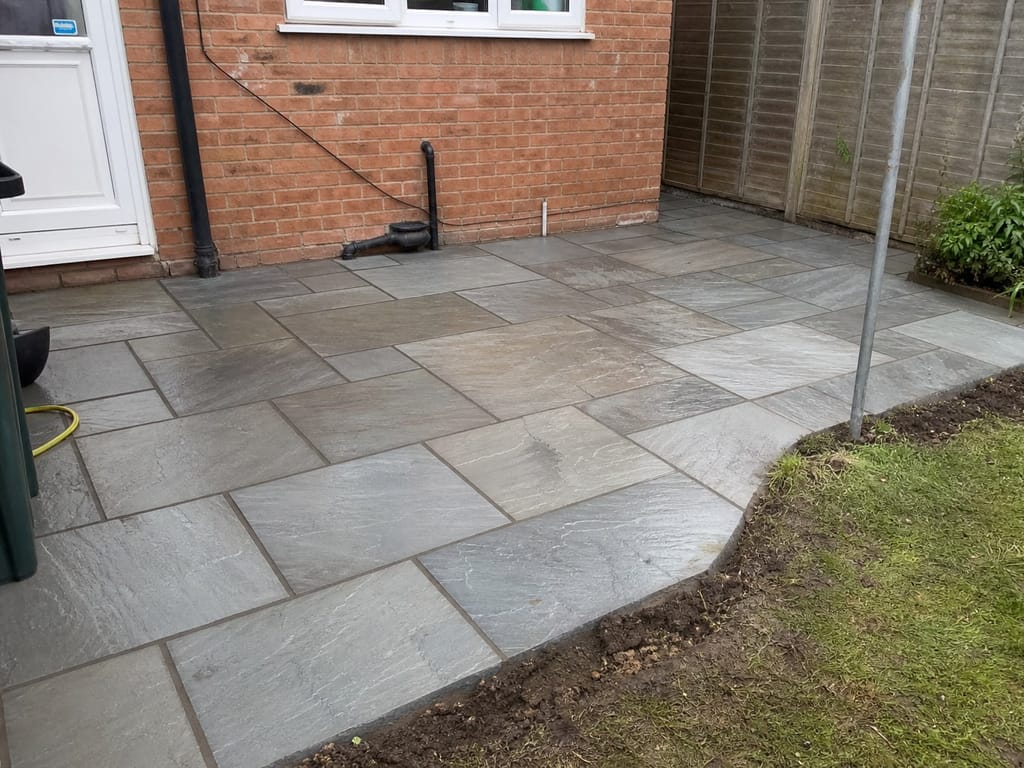
Full bed, not five spots of mortar
The fastest way to lay a slab is five dabs of mortar under the corners and middle. It is also the reason so many patios rock, ring hollow and crack down the middle within a few winters. Water gets into the voids, freezes, and lifts the slab off its dabs. We lay onto a full wet mortar bed with the slab primed on its back, so the whole underside is supported and there is nowhere for water to sit.
Those are guide bands taken from published UK cost surveys, not a quote. Your price comes from the survey and is fixed in writing.
Choosing the stone
- Indian sandstone. The default for a reason. Warm, riven, forgiving underfoot, and the cheapest natural stone by a distance. It is porous, so it darkens when wet and takes algae on a shaded north facing patio.
- Porcelain. Dense and near zero porosity, so it stays the colour you bought and shrugs off algae and wine. It costs more to buy and more to lay, because every cut needs a diamond blade and the slabs must be primed. Textured grades are the ones to use outside.
- Concrete slab. The budget option and much improved on what it was. Consistent sizes make it quick to lay. The colour is pigmented rather than natural, so it lightens over years.
- Limestone and granite. Limestone gives a flatter, more contemporary face. Granite is the hardest wearing and the heaviest to handle. Both cost more than sandstone.
Levels, falls and the damp course
A patio against the house must finish at least two brick courses, roughly 150mm, below the damp course, and it must fall away from the wall at about one in eighty. Where the ground does not allow that, the answer is a drainage channel along the wall rather than burying the damp course and hoping. We check this at the survey and it goes on the quote before you commit, because it is the difference between a patio and a damp problem.
How we build it
- Dig out. To formation, spoil carted away, existing slabs lifted and taken off site.
- Sub-base. Compacted MOT Type 1, graded to the fall.
- Lay. Full wet mortar bed, slurry primer on the back of each slab, levels rodded off a datum as we go.
- Cut. Wet cut on a bench saw. Cuts land where they are least seen, and never as a thin sliver along a wall.
- Point. Brush in jointing compound or a hand pointed mortar joint, your choice, once the bed has gone off.
- Finish. Steps built to an even rise, edges haunched, and the whole area washed down.
Aftercare
Sweep it and wash it down two or three times a year, more on a shaded patio where algae takes hold. A wide pressure washer fan is fine on porcelain and granite; go gently on sandstone and stay off the joints. Sandstone can be sealed after it has fully dried out, which slows staining but has to be redone every few years. Clear leaves off in autumn before they mark the stone.
Price up a patio
Tell us the postcode and roughly how big it is. We measure up and put a fixed price in writing.